Multi-Property Key Control
Coordinating key cabinets, local facility responsibilities, and unified portfolio access registries across commercial properties.
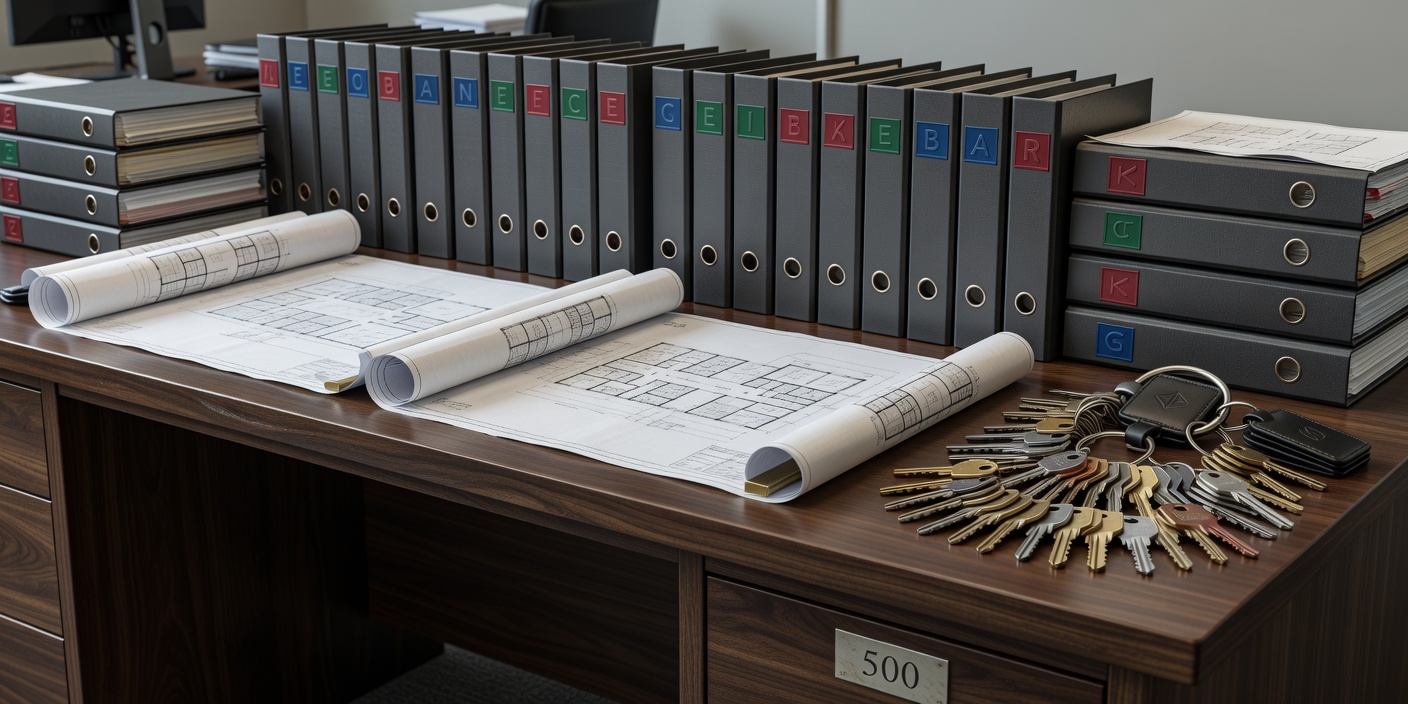
Managing key security across multiple commercial buildings introduces logistical complexity. Personnel rotate, contractors service multiple sites simultaneously, and duplicate keys proliferate if local buildings maintain informal operating standards.
1. Portfolio-Wide Master Key Hierarchies
When a property management firm oversees five, twenty, or fifty office parks and retail complexes, maintaining distinct mechanical architectures is essential. Cross-keying between separate buildings must be strictly avoided. If a master key for Building A opens service risers in Building B, an operational breach at one property automatically compromises the next.
Each property should maintain an isolated key hierarchy with designated:
- Grand Master Keys: Held in secure off-site escrow or head office emergency containment.
- Building Master Keys: Held by the dedicated site facilities manager.
- Sub-Masters (Departmental): Assigned specifically to HVAC, plumbing, or electrical contractors.
- Change Keys (Individual Doors): Assigned exclusively to individual commercial tenant spaces.
2. Centralized Records vs. Site-by-Site Ownership
Organizations typically adopt one of three models for multi-property key control:
Option A: Purely Centralized Key Operations
All physical keys are stored at a regional central desk. Facility teams collect keys each morning and return them at shift close.
Trade-off: High inventory integrity, but creates severe logistical travel delays and zero operational agility during out-of-hours emergencies.
Option B: Autonomous Property-by-Property Operations
Each building operates its own locked box and maintains its own physical paper sign-out binder.
Trade-off: High speed for local technicians, but zero portfolio visibility. Head office cannot determine how many keys are missing across the portfolio until an incident occurs.
Option C: The Hybrid Controlled Model (Recommended)
Keys remain stored in secure on-site cabinets at each property. However, all issuance, authorizations, and audits are recorded into a centralized ledger accessible by both local custodians and central portfolio operations.
3. Allocating Cross-Building Staff and Contractor Access
Mobile technicians often service air conditioning units or fire suppression systems across eight different properties in a single business week. Under disciplined multi-property key control:
- Technicians are never permitted to take keys off-site from Property A to Property B.
- Every key must be returned to the local building cabinet before the technician departs the perimeter.
- Cross-property access rights must be verified on each site arrival against the central work authorization ticket.
This policy eliminates the common risk of keys becoming lost inside contractor service vans or forgotten at another property miles away.
4. Portfolio Inventory Consistency Standards
Standardization across all facilities prevents confusion. Every building under portfolio management should implement:
- Identical tag color schemas (e.g., Red for Life Safety & Fire, Blue for Water/HVAC, Yellow for Electrical, Green for Common Tenant Areas).
- Identical log formats: date, military timestamp, key tag code, recipient name, phone, vendor ID, return signature.
- Standardized monthly physical counts performed by local custodians and submitted to central operations on the final Friday of each calendar month.
5. Escalation for Cross-Property Discrepancies
When a key is logged as missing at Property C, the incident cannot be treated as an isolated local event. The central operations desk must immediately review whether the missing key was part of a master suite that shares common cylinder pin configurations elsewhere in the portfolio. If a master is lost, prompt re-keying or cylinder pinning changes must occur to restore controlled physical security boundaries.